

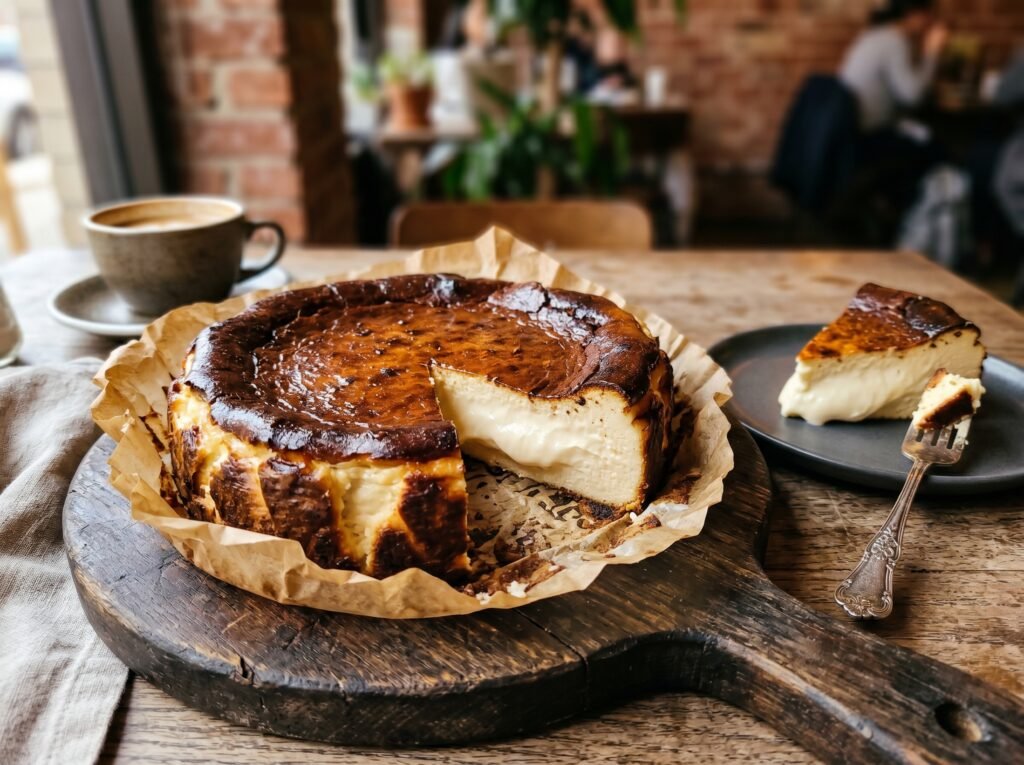
When you want an incredibly dramatic, show-stopping dessert that turns conventional baking rules completely on their head, the San Sebastian Burnt Caramel Cheesecake (also known as Basque Cheesecake) is an absolute triumph. Far from a dense, cold New York cake sitting on a graham cracker crust, a spectacular San Sebastian cheesecake relies on extreme thermal caramelization and a fluid, custardy center. This recipe delivers a beautiful bake featuring an intensely dark, deeply caramelized, almost-burnt top crust that breaks away to reveal a ultra-creamy, self-saucing, molten center. If your homemade cheesecakes consistently turn out cracks, develop a dry, graininess, or bake up completely firm all the way through, it all comes down to high-heat convection mechanics, heavy lipid-to-protein ratios, and strategic residual-heat timing.
The culinary science secret behind a cheesecake that achieves a deeply scorched, bitter-sweet caramel top while keeping a fluid, soufflé-like center is the High-Velocity Thermal Scorch and Delayed Coagulation Strategy. Traditional cheesecakes are baked slowly in a gentle water bath (bain-marie) at low heat to keep the eggs from curdling. The San Sebastian style does the exact opposite: it blasts the batter at an intense $200^\circ\text{C}$ to $220^\circ\text{C}$ ($400^\circ\text{F}$ to $425^\circ\text{F}$) without a water bath. This rapid heat triggers intense Maillard browning and pyrolysis (sugar burning) on the surface, creating a rich, bitter-sweet caramel shell that acts as a natural crust. Because the oven heat is moving so fast through the cake from the outside in, you pull the cheesecake out while the center is still completely liquid and jiggling. As it cools slowly on the counter, the trapped residual thermal energy gently cooks the interior just enough to set the proteins into a velvety, molten cream rather than baking it into a firm, solid block.
Why You’ll Love This Avant-Garde Bake
- The Ultimate Molten Custard Texture: Eliminating a water bath and under-baking the cake ensures a ultra-soft, velvety core that practically melts like a thick cream sauce on the plate.
- Complex Bitter-Sweet Flavor Profiles: The deeply browned, nearly black top shell offers notes of toasted caramel, molasses, and toasted sugar that balance the rich, tangy cream cheese.
- Completely Effortless Crustless Prep: There is no tedious cookie-crust pressing, no springform pan water-proofing foil wraps, and absolutely no worrying about surface cracks.
- A Visual and Textural Masterpiece: Slicing into a rustic, dark, puffed-up cake to reveal an oozing, smooth ivory center provides an incredible, high-end restaurant experience.
Key Ingredients Overview
- Full-Fat Brick Cream Cheese: The velvety foundation. You must use full-fat block style, as it contains the proper ratio of milk fats and solids needed to build a stable emulsion without weeping.
- Heavy Whipping Cream (Minimum 35% Fat): The liquefying lipid. Heavy cream thins out the dense cheese proteins, ensuring the interior stays fluid and custardy rather than dense and firm.
- Fresh Whole Eggs: The structural binder. Egg proteins unwind and cross-link during baking to hold the liquid cream and cheese together, acting as the sole setting agent.
- A Tiny Pinch of Flour: The emulsion insurance. Just a single tablespoon of flour stabilizes the fats and starches, preventing the batter from curdling or breaking under intense heat.
Step-by-Step Instructions
1.The Room Temperature Lipid Equilibrium:10 min.
Set your cream cheese, eggs, and heavy cream on the counter for at least 2 hours before baking. Every single ingredient must be completely at room temperature. If the cheese is cold, it will form tiny, stubborn hydrophobic lumps that destroy the silky, fluid texture of the molten center.
2.The Rustic Double-Parchment Pan Lining:5 min.
Preheat your oven to 210°C (410°F). Lightly grease an 8-inch or 9-inch springform pan. Take two large sheets of parchment paper and press them into the pan, overlapping them crosswise so the paper extends at least 2 to 3 inches above the rim. Crinkle the paper loosely into the corners; those rustic, irregular folds give the baked cheesecake its iconic, beautiful pleated edges.
3.The Low-Aeration Cheese and Sugar Smooth:5 min.
In a large mixing bowl (or stand mixer fitted with the paddle attachment), beat your softened cream cheese and sugar on medium-low speed for 2 minutes until completely smooth, glossy, and grain-free. Keep the mixer speed low; you want to dissolve the sugar without whipping excess air bubbles into the batter, which would cause the cake to explode and collapse like a hollow soufflé.
4.The Sequential Egg Protein Integration:3 min.
Add your room-temperature eggs one at a time to the smooth cheese matrix, mixing thoroughly on low speed after each addition. Scraping down the bottom and sides of the bowl with a silicone spatula between eggs ensures a completely homogenous, silky emulsion.
5.The Heavy Cream and Starch Slurry Liaison:2 min.
In a small cup, whisk your tablespoon of all-purpose flour into a small splash of the heavy cream until a smooth paste forms (this avoids flour lumps). Pour the remaining heavy cream, the flour paste, vanilla extract, and salt into the main batter. Mix on low for 1 minute until the batter is thin, glossy, and pourable.
6.The High-Velocity Intense Surface Scorch Bake:25 min.
Pour the fluid batter into your prepared parchment-lined pan. Slide into the middle rack of the preheated oven and bake at 210°C (410°F) for 23 to 25 minutes. Watch closely: the cheesecake will puff up high like a soufflé and turn a deep, dark mahogany-brown. Pull it out while the center is still completely fluid and violently jiggles like jelly when the pan is nudged.
7.The Static Ambient Cooling Custard Set:4 hr.
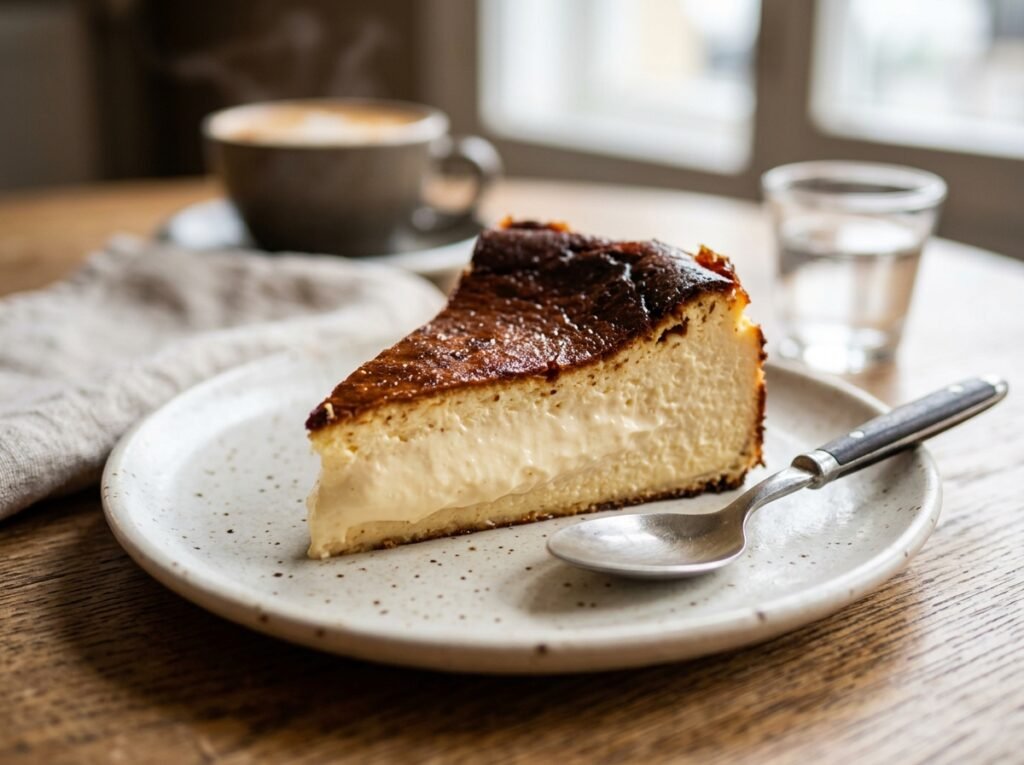
Place the hot pan on a wire rack and let it cool completely at room temperature. As it cools, the puffed cake will gently deflate, creating a beautiful, sunken rustic top, and the fluid center will slowly set into a molten custard. Do not refrigerate it if you want an oozy center—serve it at room temperature within 4 to 6 hours of baking.
Expert Tips for Success
- The Room-Temp Mandate: Cold ingredients are the absolute enemy of a smooth Basque cheesecake. Cold cream cheese will wrap around itself and create millions of tiny white flecks that cannot be beaten out without over-mixing. Over-mixing introduces too much air, causing the cake to puff and drop aggressively, leaving a rubbery texture.
- The Violent Jiggle Law: Do not be afraid when you pull this cake out of the oven and the center looks completely liquid, unbaked, and wiggly. If you bake it until the center is stable and firm, you have over-cooked the egg proteins; once cooled, the cheesecake will turn into a standard, dense, solid block instead of a molten, oozing cream.
- Never Serve Cold: To experience the true, legendary San Sebastian texture, never serve this cake straight out of the refrigerator. Cold temperatures solidify the butterfats and cream lipids, locking the center into a firm paste. Let the cake cool completely on the counter and slice it at true room temperature for that maximum, self-saucing ooze.
The Recipe Card
- Prep Time: 15 mins (+ 2 hours warming ingredients)
- Cook Time: 25 mins
- Total Time: 40 mins
- Yield: 8 Elegant, Molten Dessert Servings
Ingredients:
- The Rich Cheese Foundation: 600g (21 oz) Brick Cream Cheese (full-fat, completely at room temperature), 170g (¾ cup) Fine Granulated Sugar.
- The Emulsion Binders: 4 Large Eggs (room temperature), 1 tsp Pure Vanilla Extract, ½ tsp Fine Sea Salt.
- The Fluid Slurry Matrix: 350ml (1 ½ cups) Heavy Whipping Cream (35% fat, room temperature), 1 tbsp All-Purpose Flour.
Instructions:
Bring all ingredients completely to room temperature. Preheat your oven to 210°C (410°F). Line an 8-inch or 9-inch springform pan with two overlapping sheets of parchment paper, ensuring the paper extends 2–3 inches above the rim. In a large bowl, beat the cream cheese and sugar together on medium-low speed for 2 minutes until glossy and smooth. Add the eggs one at a time, mixing on low speed until combined, scraping the bowl frequently. In a small cup, mix the flour with a splash of the heavy cream until smooth, then pour that paste, the rest of the heavy cream, vanilla, and salt into the cheese batter. Mix on low just until a thin, pourable batter forms. Pour into the pan and bake for 23–25 minutes until the top is deeply caramelized and dark brown, but the center still jiggles violently when moved. Let cool completely on a wire rack at room temperature for 4 hours. Do not chill. Carefully peel back the parchment paper, slice, and serve at room temperature.
