

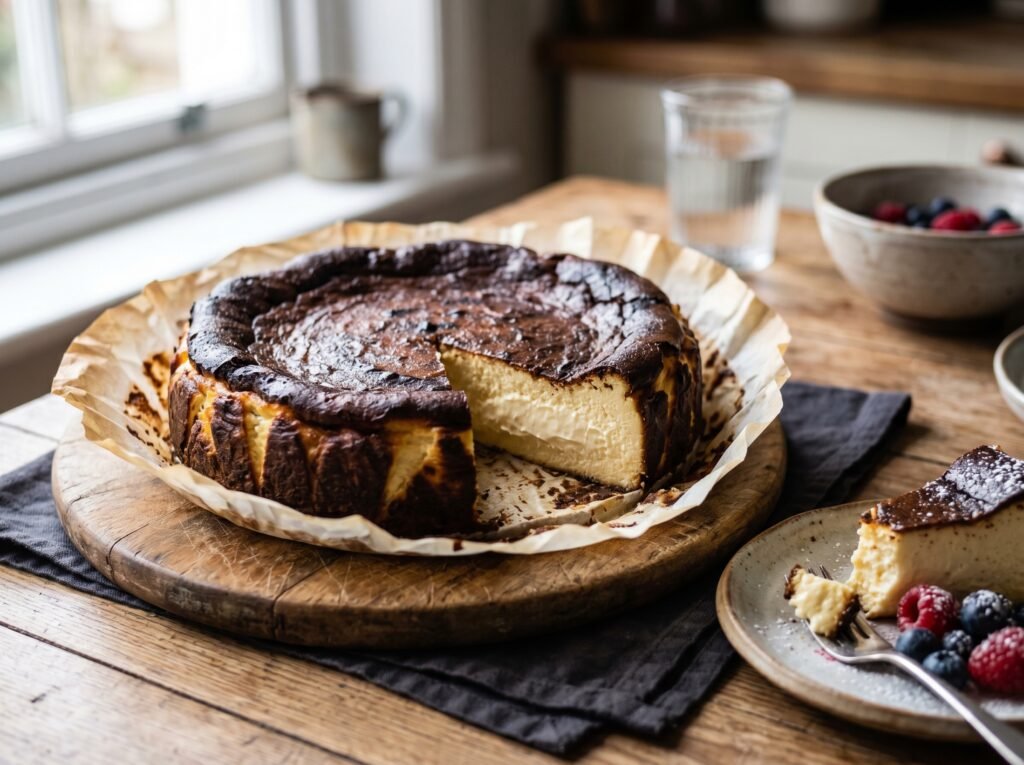
Born in the early 1990s at a small bar called La Viña in San Sebastián, Spain, the Basque Burnt Cheesecake completely upended traditional pastry rules. Unlike a classic New York style cheesecake, which demands a perfectly flat, pale top and a buttery biscuit crust, this Spanish icon completely embraces chaos. It has no crust, features an aggressively scorched, almost blackened top, and is baked at an intensely high heat. Break through that deeply caramelized exterior, and the center reveals an impossibly rich, custardy texture that behaves almost like a thick, warm pudding.
The engineering challenge of a San Sebastian cheesecake is mastering the art of intentional overcooking and undercooking simultaneously. If you bake it too long, you lose the fluid, molten core; if you pull it out too soon, the top won’t char and the cake will collapse into a puddle. To strike the perfect balance, we use the High-Heat Scorching Strategy. By cooking the batter at a soaring 200°C (400°F) without a water bath, the intense heat triggers the Maillard reaction and caramelizes the surface sugars rapidly, creating an intense, bitter-sweet, dark-brown “crust” out of the dairy itself. Meanwhile, the high temperature cooks the outer rim solid while leaving the absolute center barely set, creating a gorgeous gradient of textures.
Why You’ll Love This Sweet Treat
- Zero Baking Stress: Forget about buying graham crackers, rolling dough, or wrapping pans in multiple layers of aluminum foil. This cake requires no crust and no fussy water bath.
- The Magic of Caramelization: The scorched top isn’t just for show—it yields a complex, bitter-sweet caramel flavor note that perfectly balances the rich, tangy fat profile of the inner cream cheese.
- A Flowing, Melt-in-Your-Mouth Core: Because it is baked without a water jacket buffer, the core cooks into an ultra-creamy, almost flowing texture that melts the second it hits your tongue.
- Beautifully Forgiving: Cracks, wrinkles, and deep folds aren’t flaws here—they are the hallmarks of an authentic, rustic Basque bake.
Key Ingredients Overview
- Full-Fat Brick Cream Cheese: Just like its New York cousin, this recipe depends on dense, high-quality baking cream cheese blocks. Low-fat or spreadable varieties contain too much water and will prevent the cake from setting.
- Heavy Whipping Cream (35%+ Fat): This provides the necessary liquid density to loosen the cream cheese block matrix, creating a fluid batter that bakes into a gorgeous, smooth custard.
- A Whisper of Flour: We use just a tiny spoonful of all-purpose flour to help bind the eggs and heavy dairy. This gives the cake just enough structural integrity to hold its shape once sliced, without turning it cakey.
- Granulated White Sugar: Sugar is absolutely critical for the structural chemistry here; it caramelizes at high heat to build that iconic, deep brown top armor.
Step-by-Step Instructions
1.The High-Heat Oven Target:2 min.
Preheat your oven to 200°C (400°F). Position your oven rack right in the upper-middle slot so the top of the cheesecake sits close to the heating elements.
2.The Crumpled Parchment Armor:5 min.
Take a large sheet of parchment paper (about 16 inches square) and crumple it tightly into a ball with your hands, then flatten it back out. Press this wrinkled sheet firmly into a 9-inch springform pan, ensuring it lines the bottom and climbs at least 2 inches above the top rim of the pan. This creates a rustic, high-walled cradle for the expanding batter.
3.The Smooth Sugar Emulsion:5 min.
In a large bowl, combine your fully softened room-temperature cream cheese and granulated white sugar. Using an electric mixer fitted with the paddle attachment, beat on medium-low speed for about 2 to 3 minutes until the sugar dissolves and the mixture is completely smooth and devoid of lumps.
4.The Steady Egg Incorporation:4 min.
Add your room-temperature eggs to the cream cheese mixture one at a time, beating on low speed just until each yolk disappears before adding the next. This prevents you from whipping excess air into the dense dairy matrix.
5.The Cream and Flour Ribbon:3 min.
In a separate measuring cup, whisk your heavy whipping cream and all-purpose flour together until completely smooth and lump-free. With the mixer running on low, slowly pour this cream ribbon into the batter, followed by the vanilla extract and salt. Mix just until combined into a smooth, pourable liquid.
6.The High-Wall Pan Fill:1 min.
Pour the smooth batter directly into your prepared parchment-lined springform pan. Tap the pan firmly against your kitchen counter 3 times to force any massive trapped air bubbles to rise to the surface and pop.
7.The Intensely Burnt Scorching Bake:45 min.
Bake at 200°C (400°F) for 40 to 45 minutes. Watch the cake closely during the final 5 minutes—the top should puff up high like a soufflé and develop a deep, uniform, burnt dark-brown color.
8.The Molten Jiggle Counter Rest:4 hr.
Remove the pan from the oven. Do not touch it! The center of the cake will look incredibly loose and jiggle aggressively like a bowl of liquid gelatin—this is exactly what you want. Place the pan on a wire rack and let it cool completely to room temperature. As it cools, the puffed cake will gently collapse inward, forming beautiful, rustic wrinkled folds. Serve slightly warm or transfer to the fridge to chill for a firmer texture.
Expert Tips for Success
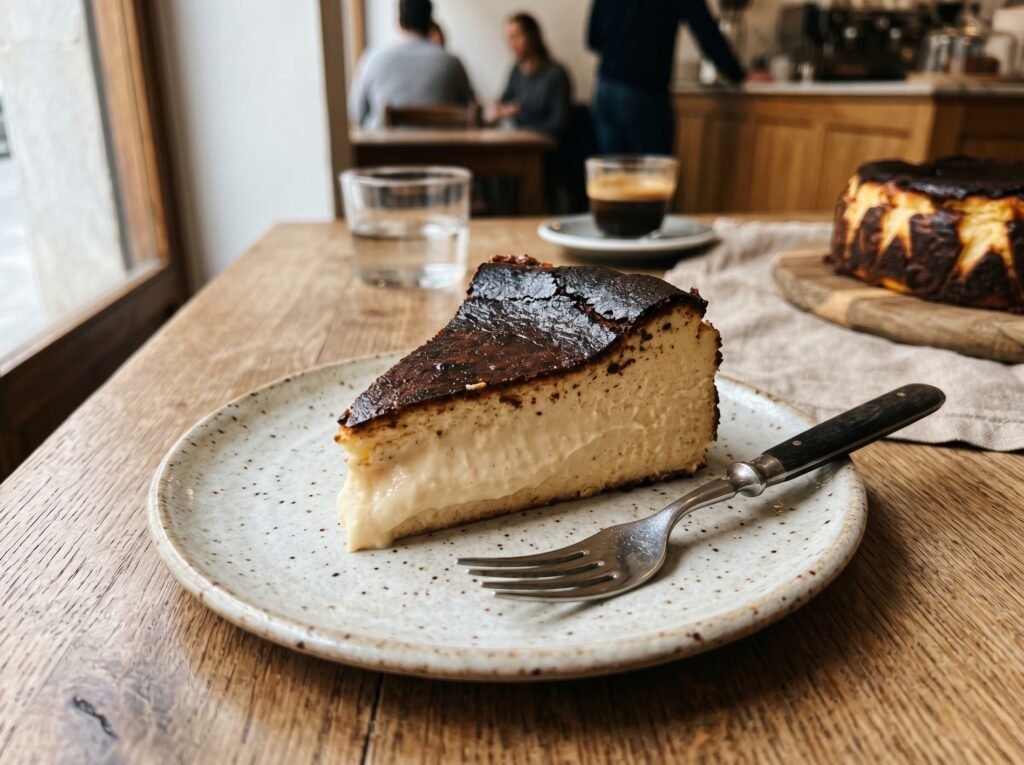
- Do Not Panic at the Jiggle: The most common mistake is overbaking this cake because it looks raw when the timer goes off. The center must wobble violently when you pull it out. The residual heat trapped inside the heavy dairy will finish setting the custard as it cools on your counter, keeping the core perfectly creamy.
- Embrace the Crumpled Paper: Do not try to trim the parchment paper to fit the pan perfectly. The crinkled, overlapping folds of paper are what give the San Sebastian cheesecake its iconic, rough, rustic outer edges. Furthermore, the high parchment paper walls prevent the rising batter from spilling over into your oven.
- Room Temperature is Non-Negotiable: Because this batter is highly liquid, any cold cream cheese will instantly separate into tiny, solid dots that float around the bowl. Ensure your cream cheese, eggs, and heavy cream sit on your counter until they reach true room temperature before you begin mixing.
The Recipe Card
- Prep Time: 20 mins
- Cook Time: 45 mins
- Cooling Time: 4 hrs
- Total Time: 5 hrs 5 mins
- Yield: 10 to 12 Rich Slices
Ingredients:
- 800g (approx. 3 ½ blocks / 28 oz) Brick Cream Cheese (fully softened to room temp)
- 220g (1 cup) Granulated White Sugar
- 5 Large Eggs (room temperature)
- 400ml (1 ¾ cups) Heavy Whipping Cream (35%+ fat)
- 20g (2 tbsp) All-Purpose Flour
- 1 tsp Pure Vanilla Extract
- ¼ tsp Fine Sea Salt
Instructions:
Preheat oven to 200°C (400°F). Crumple a large sheet of parchment paper, unroll it, and press it firmly into a 9-inch springform pan, allowing the excess paper to extend at least 2 inches above the rim. Using a mixer on medium-low speed, beat the softened cream cheese and sugar together for 3 minutes until smooth and sugar is dissolved. Add eggs one at a time on low speed, mixing just until incorporated. In a small bowl, whisk the flour into the heavy cream until smooth, then pour it into the batter along with the vanilla and salt; mix on low just until unified. Pour into the pan and tap to release large air bubbles. Bake for 40-45 minutes until the top is deeply dark brown and scorched, but the center still jiggles dramatically. Cool completely on a wire rack at room temperature before releasing the springform collar and peeling back the paper.
