

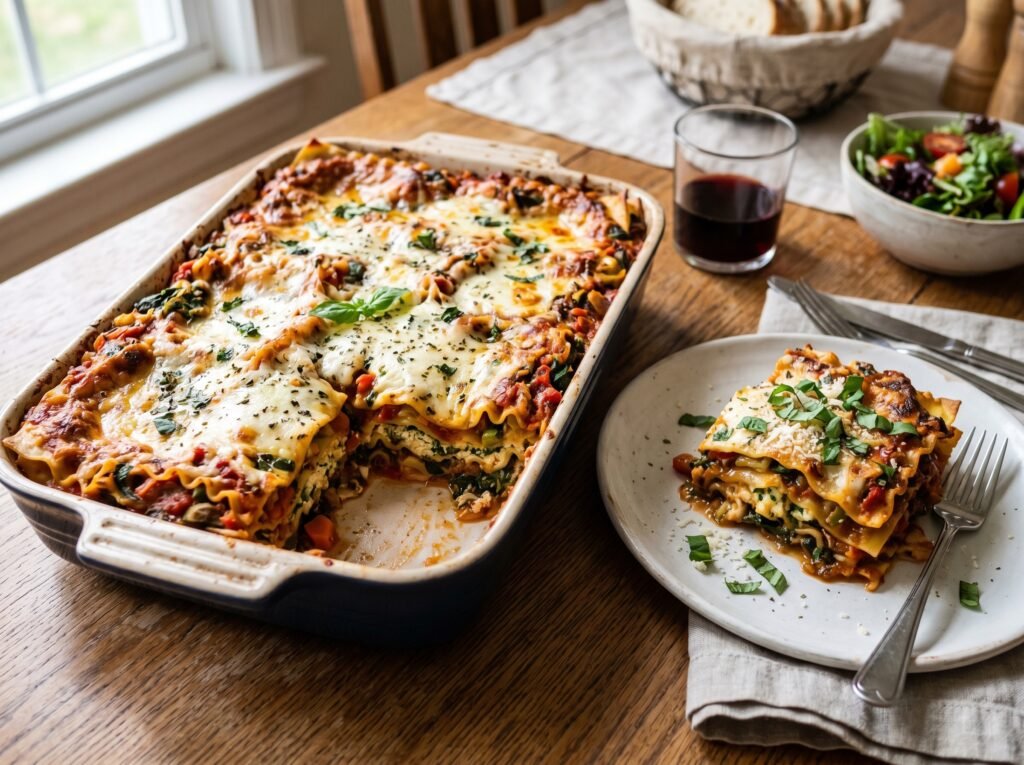
When looking for a savory vegetarian centerpiece that delivers absolute comfort and opulence, a perfectly layered Vegetarian Lasagna with Ricotta stands completely unrivaled. Far from a watery, unstructured mess of loose vegetables or a dry, heavy brick of pasta, an elite vegetable lasagna is a symphony of structural integrity and flavor balance. It features paper-thin layers of tender pasta sheets binding together a rich, slow-simmered garlic tomato sauce, sweet herb-roasted garden vegetables, and an incredibly creamy, cloud-like ricotta cheese filling scented with fresh nutmeg. If your homemade vegetable lasagnas consistently turn out soupy and collapse into a puddle on the plate, taste bland and watery, or feature rubbery cheese layers, it all comes down to cell-wall moisture extraction and the chemistry of dairy emulsification.
The culinary science secret behind a firm, structurally sound lasagna slice that holds its layered architecture perfectly is the High-Heat Vegetable Dehydration and Egg-Bound Ricotta Stabilization Strategy. Summer vegetables like zucchini and mushrooms are loaded with internal water bound inside their cell walls. If you layer them raw or lightly sautéed into a lasagna, that moisture releases during baking, flooding the pan and diluting the sauce. By roasting the sliced vegetables at a high heat of $220^\circ\text{C}$ ($425^\circ\text{F}$) before assembly, you collapse those cellular moisture pockets, concentrating their natural sugars and locking in their texture. Concurrently, mixing a fresh egg into your creamy ricotta mixture provides a heat-coagulating protein web. As the lasagna bakes, the egg protein tightens, setting the ricotta into a stable, velvety cushion that prevents the pasta layers from sliding apart when sliced.
Why You’ll Love This Comfort Classic
- Flawlessly Layered and Non-Watery: The initial high-heat vegetable roasting step guarantees a thick, rich lasagna that holds its beautiful cross-section when cut.
- An Impossibly Creamy, Herbaceous Core: Whip-stretching the fresh ricotta with parmesan, pecorino, and egg creates a luxurious, savory dairy filling.
- A High-Contrast Texture Matrix: Melted, bubbling, blistered mozzarella on top gives way to tender pasta sheets and toothsome, caramelized roasted vegetables.
- An Outstanding Make-Ahead Feast: This dish actually improves structurally and flavor-wise as it rests, making it the absolute perfect centerpiece for stress-free hosting.
Key Ingredients Overview
- Fresh or Quality No-Boil Lasagna Sheets: Provide the essential structural columns of the dish. No-boil sheets are highly recommended because they absorb excess moisture from the tomato sauce as they hydrate in the oven, tightening the overall bake.
- Zucchini, Bell Peppers, and Cremini Mushrooms: An optimal vegetable trio that offers contrasting color, sweet caramelized notes, and a deeply savory, meaty umami bite when roasted.
- Whole-Milk Ricotta Cheese: Provides a smooth, milky, and slightly sweet foundation. Whole-milk dairy is crucial here; low-fat alternatives lack the necessary fat stability and can curdle or turn grainy under high heat.
- A Touch of Freshly Grated Nutmeg: The ultimate Italian secret. A tiny microplane scratch of fresh nutmeg into the white ricotta matrix unlocks an incredibly complex, warm aroma that completely elevates the dairy notes.
Step-by-Step Instructions
1.The High-Heat Thermal Vegetable Dehydration Prep:10 min.
Preheat your oven to 220°C (425°F). Chop your zucchini into 1/4-inch half-moons, slice your cremini mushrooms into thick flats, and chop your red bell pepper into bite-sized squares. Toss them all on a large baking sheet with 2 tablespoons of olive oil, dried oregano, salt, and black pepper.
2.The Roasting Sugar Concentration Blast:20 min.
Spread the seasoned vegetables in a strict single layer across the baking sheet—do not crowd them, or they will steam instead of brown. Roast at 220°C (425°F) for 20 minutes, tossing halfway through, until the edges are beautifully browned and blistered. Remove from the oven and drop the temperature to 190°C (375°F).
3.The Egg-Bound Ricotta Protein Stabilization Whisk:5 min.
In a medium bowl, combine your whole-milk ricotta, half of your grated Parmesan, a whole egg, a handful of finely chopped fresh basil, a pinch of salt, and a tiny grating of fresh nutmeg. Whisk vigorously until the egg is completely integrated and the cheese forms a smooth, whipped, stable paste.
4.The Garlic-Herb Marinara Gravy Simmer:10 min.
While things cool slightly, warm 1 tablespoon of olive oil in a saucepan over medium heat. Sauté your minced garlic and crushed red pepper flakes for 1 minute. Pour in your crushed tomatoes and a pinch of sugar. Simmer gently for 8 to 10 minutes until the sauce thickens slightly into a rich, aromatic marinara.
5.The Low-Fat Base Fluid Layer Foundation:5 min.
Grab a deep 9×13-inch baking dish. Spread a thin, 1/2-cup layer of your hot tomato sauce across the very bottom of the dry dish. This provides an initial lipid-fluid barrier that prevents the bottom pasta sheets from sticking or burning against the hot ceramic.
6.The Architecture-Grid Structural Sheet Alignment:5 min.
Lay 3 lasagna noodles side-by-side directly over the bottom sauce, overlapping them slightly if necessary to form a solid pasta floor. Dollop one-third of your stabilized ricotta mixture over the pasta, smoothing it out with an offset spatula into a thin, uniform blanket.
7.The Vegetable Umami and Cheese Lattice Stack:5 min.
Scatter one-third of your sweet roasted vegetable mix across the ricotta blanket. Top with a generous handful of shredded low-moisture mozzarella cheese. Repeat this exact sequence twice more: Pasta -> Ricotta -> Roasted Veggies -> Mozzarella.
8.The Final Mozzarella Crown and Aluminum Lock:5 min.
Top the final vegetable layer with your last 3 pasta sheets. Pour the remaining tomato sauce smoothly over the top, making sure to fully coat the edges of the pasta so they don’t dry out. Strew the remaining mozzarella and Parmesan cheese across the top. Tent the dish tightly with aluminum foil so it doesn’t touch the cheese.
9.The Dual-Phase Thermal Bake and Resting Cool:45 min.
Bake at 190°C (375°F) covered with foil for 25 minutes to trap steam and cook the pasta. Remove the foil and bake uncovered for another 15 to 20 minutes until the cheese crown is bubbling and fiercely golden-brown. Crucial: Remove from the oven and let it sit undisturbed for 15 full minutes before slicing to let the layers solidify.
Expert Tips for Success
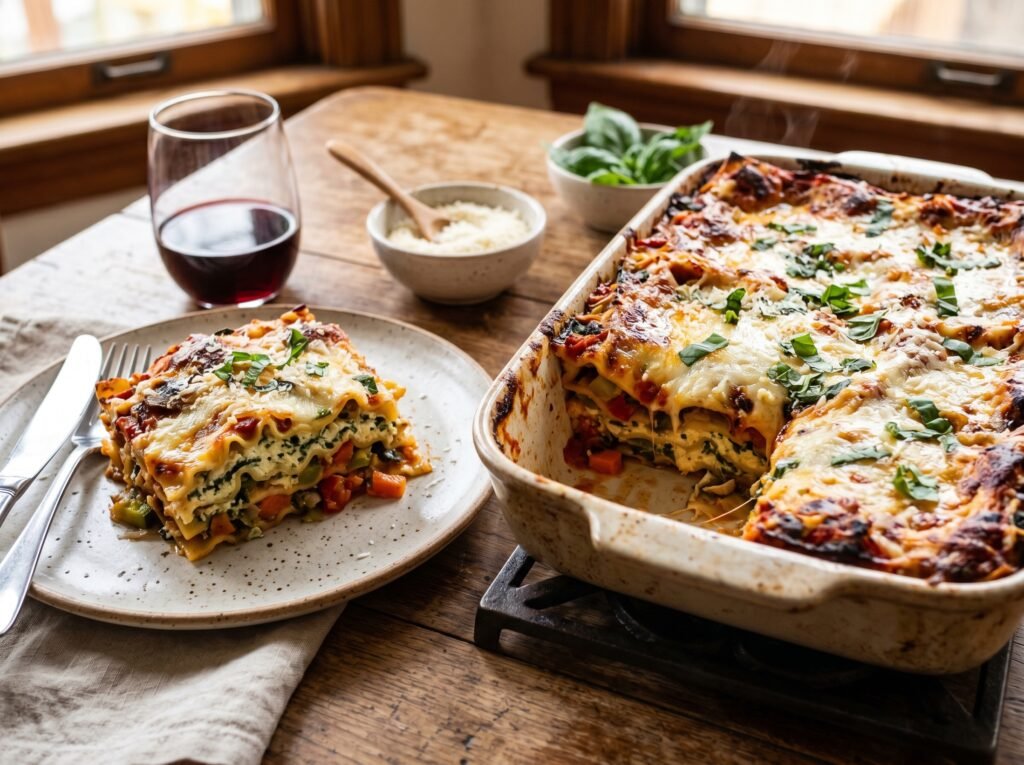
- The 15-Minute Rest Rule: Never slice into a hot lasagna straight out of the oven. When boiling hot, the cheese lipids and starch complexes are fluid and loose. Slicing immediately will cause the layers to slide apart instantly, creating a messy heap on the plate. Resting for 15 minutes allows the egg proteins in the ricotta to set completely and the starch to firm up, yielding perfect, clean, restaurant-quality layers.
- Choose Low-Moisture Mozzarella: For the shredded cheese layers, always purchase traditional “low-moisture” blocks of mozzarella rather than balls of fresh mozzarella stored in water (fior di latte). Fresh mozzarella contains a massive water-to-fat ratio that will melt into a watery pool inside your lasagna, destroying the structural integrity you built.
- The Edge-Coating Sauce Strategy: When applying the very top layer of tomato sauce, use a spoon to paint it completely over the noodles, ensuring no dry pasta edges are peeking through. Any bare pasta edges left exposed to the dry radiant heat of the oven will curl upward, dehydrate, and cook into a hard, brittle, inedible cracker texture.
The Recipe Card
- Prep Time: 30 mins
- Cook Time: 45 mins
- Total Time: 1 hr 15 mins (plus 15 mins resting time)
- Yield: One Massive, Deep-Dish Tray (8 Heavy, Satisfying Servings)
Ingredients:
- The Herb-Roasted Vegetables: 2 Medium Zucchini (sliced into half-moons), 250g (8 oz) Cremini Mushrooms (sliced), 1 Large Red Bell Pepper (chopped), 2 tbsp Extra Virgin Olive Oil, 1 tsp Dried Oregano, ½ tsp Fine Sea Salt, ¼ tsp Black Pepper.
- The Stabilized Ricotta Cushion: 425g (15 oz) Whole-Milk Ricotta Cheese, 1 Large Egg, 50g (½ cup) Grated Parmesan Cheese (divided), 15g (¼ cup) Fresh Basil Leaves (finely chopped), A tiny pinch of Freshly Grated Nutmeg, ¼ tsp Salt.
- The Quick Garlic Marinara: 1 tbsp Extra Virgin Olive Oil, 3 Cloves Garlic (minced), ¼ tsp Crushed Red Pepper Flakes, 1 Can (800g / 28 oz) High-Quality Crushed Tomatoes, ½ tsp Sugar, ½ tsp Salt.
- The Pasta and Assembly Armor: 12 High-Quality No-Boil Lasagna Sheets, 340g (3 cups) Low-Moisture Mozzarella Cheese (shredded).
Instructions:
Preheat your oven to 220°C (425°F). Toss the chopped zucchini, mushrooms, and bell pepper with 2 tbsp olive oil, oregano, salt, and pepper on a large baking sheet; arrange in a single layer and roast for 20 minutes until caramelized. Lower the oven temperature to 190°C (375°F). In a bowl, whisk together the ricotta, egg, half of the grated Parmesan, chopped basil, a pinch of salt, and a grating of fresh nutmeg until smooth. In a small pot over medium heat, warm 1 tbsp olive oil and sauté the minced garlic and red pepper flakes for 1 minute; pour in the crushed tomatoes, sugar, and salt, simmering for 8-10 minutes until slightly thickened. Spread ½ cup of the tomato sauce across the bottom of a 9×13-inch baking dish. Lay 3 lasagna noodles over the sauce, spread one-third of the ricotta mixture on top, scatter one-third of the roasted vegetables, and dust with a handful of shredded mozzarella. Repeat this layering pattern twice more. Top with the final 3 pasta sheets, the remaining tomato sauce (coating the noodles completely), and the rest of the mozzarella and Parmesan. Cover tightly with foil and bake at 190°C (375°F) for 25 minutes; remove the foil and bake uncovered for another 15-20 minutes until the top is bubbling and deep golden-brown. Let rest for 15 minutes before slicing.
