

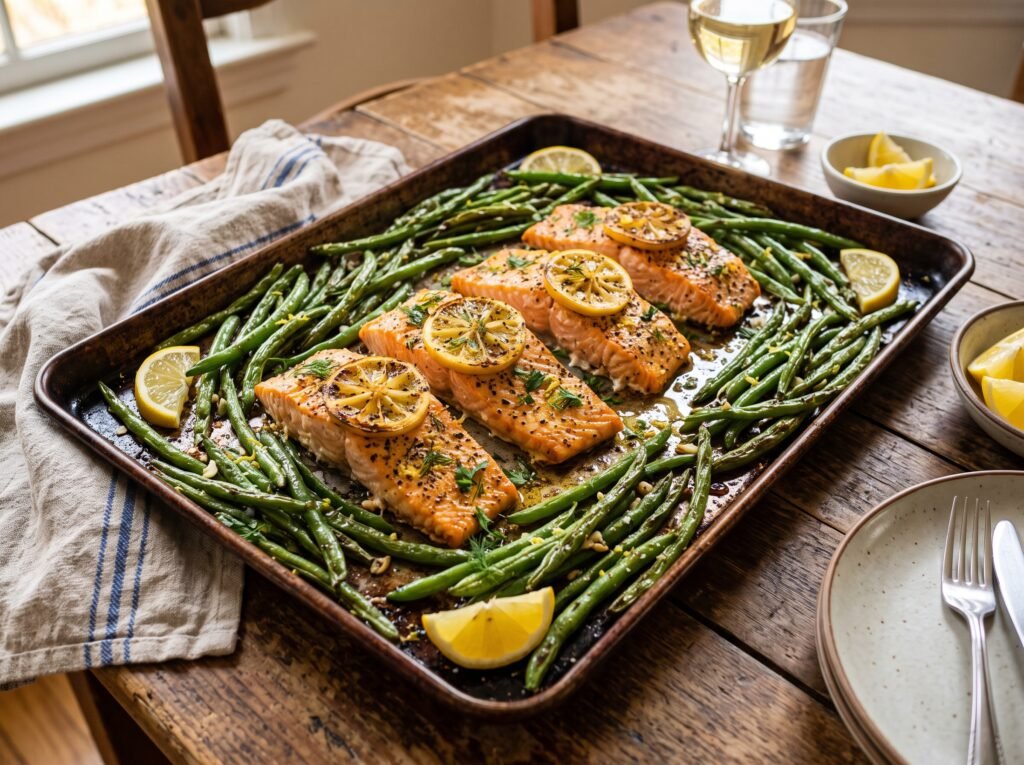
When you want an incredibly vibrant, texturally flawless, and deeply satisfying seafood dinner that requires virtually zero cleanup, Sheet Pan Lemon Pepper Salmon with Green Beans is an absolute triumph. Far from a dry, chalky fish fillet or a pile of limp, squeaky, waterlogged vegetables, an elite sheet pan bake relies on precise thermal heat conductivity and oil-soluble aromatic binding. This recipe delivers perfectly flaky, buttery salmon sections kissed with an assertive, zesty citrus-peppercorn glaze, paired with snap-tender, blistered French green beans. If your homemade sheet pan salmon dinners consistently result in overcooked fish, mushy greens, or a pool of unappealing white moisture on the pan, it all comes down to lipid-moisture barriers, calculated convection spacing, and targeted oven temperatures.
The culinary science secret behind successfully cooking seafood and fresh vegetables together on a single tray without ruining the texture of either is the Lipid Moisture Shield and High-Heat Blister Convection Strategy. Salmon is packed with delicate, heat-sensitive proteins like albumin. If you bake salmon dry or at too low a temperature, these proteins tighten up violently and squeeze out internal water, creating dry flakes and an unsightly white coating on the surface. By brushing the salmon fillets with a thick emulsion of clarified butter or olive oil, lemon zest, and cracked peppercorns, you form a protective lipid blanket that seals in moisture. Concurrently, green beans contain high amounts of surface water. When roasted at a high $200^\circ\text{C}$ ($400^\circ\text{F}$) with a light oil coat and plenty of breathing room, that surface water vaporizes instantly. This triggers the Maillard reaction, charring the tips of the beans into a smoky sweetness while keeping the core beautifully snap-tender.
Why You’ll Love This Streamlined Sheet Pan Meal
- Incredibly Flaky, Buttery Seafood Core: A calculated lipid glaze shields the fish, ensuring it stays perfectly tender and juicy inside.
- Staggeringly Crisp, Blistered Greens: Roasting at a high heat converts surface moisture into crisp caramelization, completely bypassing any sogginess.
- The Ultimate 20-Minute Weeknight Rescue: By utilizing a single baking sheet, prep time is minimalized and cleanup takes under two minutes.
- An Assertive, Zesty Flavor Burst: Utilizing raw lemon zest rather than just juice packs an intense citrus punch without turning the fish mushy.
Key Ingredients Overview
- Center-Cut Skin-On Salmon Fillets: The structural seafood anchor. Uniform center-cut fillets cook at an even rate, while the skin protects the bottom from drying out against the pan.
- Fresh French Green Beans (Haricots Verts): The crisp vegetable element. Thinner than standard string beans, they blister and tenderize rapidly in the oven.
- Coarsely Cracked Black Peppercorns: The flavor driver. Using large, freshly cracked peppercorns instead of pre-ground powder delivers a sharp, aromatic crunch.
- Fresh Organic Lemons: The acid balance. Grating the outer rind unlocks intense essential oils (limonene) that cut through the rich, heavy fats of the salmon.
Step-by-Step Instructions
1.The High-Conduction Sheet Pan Pre-Heat:3 min.
Place a large, heavy-rimmed baking sheet directly into the middle rack of your oven and preheat to 200°C (400°F). Preheating the dry baking sheet ensures that the moment your green beans hit the hot metal, surface moisture vaporizes instantly, kicking off rapid blistering.
2.The Dry Salmon Surface Moisture Purge:5 min.
Pull your salmon fillets from the refrigerator. Use paper towels to aggressively pat the flesh and skin bone-dry. Let them sit at room temperature for 5 minutes. Removing this cold surface moisture prevents the fish from steaming in its own juices, ensuring a clean, caramelized top.
3.The Essential Oil Citrus-Pepper Emulsion:3 min.
In a small bowl, whisk together your extra virgin olive oil (or melted butter), finely grated lemon zest, freshly cracked black pepper, garlic powder, and fine sea salt. Blending the spices into the oil coats the aromatics, preventing the delicate pepper and garlic from burning under the oven heat.
4.The Hydrophobic Vegetable Oil Toss:3 min.
Trim the tough stem ends off your green beans and dry them completely in a towel. Place them in a bowl, drizzle with 1 tablespoon of olive oil, and toss with a pinch of salt. The thin oil coating acts as a thermal conductor, rapidly transferring the oven’s heat to blister the bean skins.
5.The Protective Lipid Coating Paint:2 min.
Lay your dry salmon fillets skin-side down on a plate. Use a pastry brush or the back of a spoon to thickly paint the lemon-pepper oil emulsion across the top and sides of each fillet. Press down gently to ensure the cracked peppercorns adhere tightly to the flesh.
6.The High-Heat Convection Spatial Roast:12 min.
Carefully pull the roaring hot baking sheet from the oven. Arrange your seasoned salmon fillets down the center of the pan. Scatter the oiled green beans into the open spaces around the fish in a single, sparse layer. Keep a clear space between the beans; overcrowding will trap steam and turn them mushy. Roast for 10 to 12 minutes.
7.The Acid-Citrus Balance Finish:1 min.
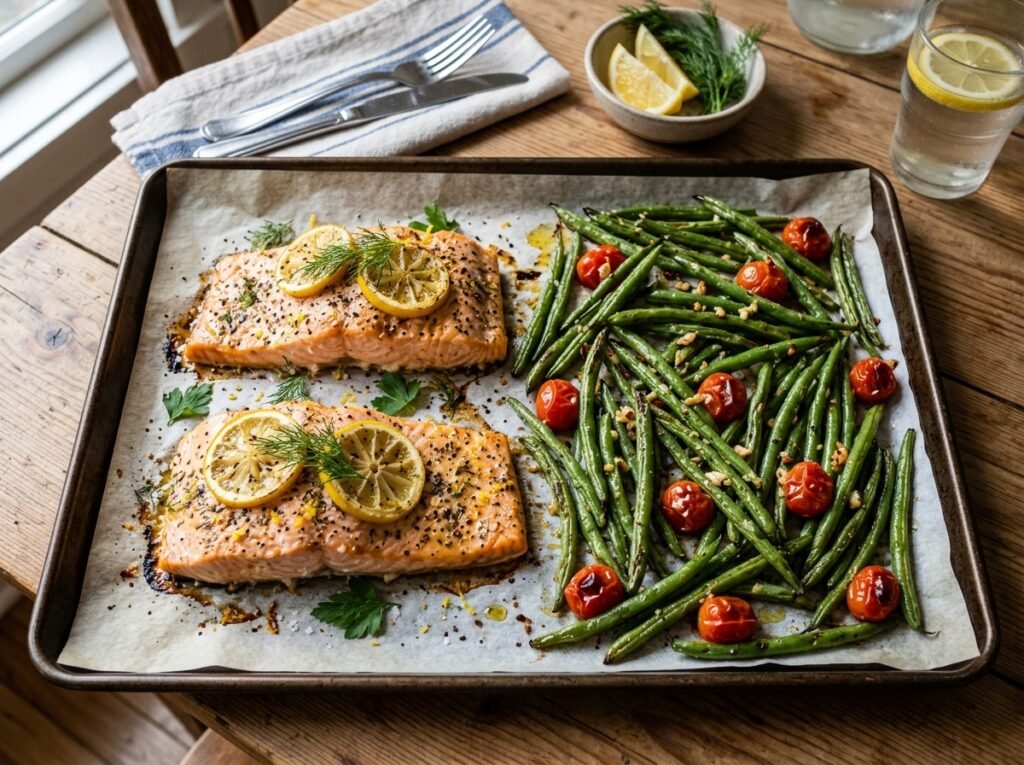
Slide a sharp knife into the thickest part of the salmon; it should flake easily and look slightly translucent in the absolute center (registering 52°C/125°F for medium-rare). Remove from the oven. Immediately squeeze fresh lemon juice over the hot fish and blistered green beans. Serve directly from the pan.
Expert Tips for Success
- The Pre-Ground Pepper Ban: Never use pre-ground black pepper from a shaker canister for this dish. Pre-ground pepper is dry, dusty, and loses its aromatic oils quickly, leaving your fish tasting bitter and harsh. Coarsely crack whole peppercorns using a pepper mill or by crushing them with the bottom of a heavy skillet. This builds an elite, textured crust.
- The Room Temperature Law: Avoid dropping freezing-cold salmon fillets directly from the fridge onto the hot sheet pan. If the fish is too cold, the outer layers will overcook and dry out before the center can even warm through, forcing out white albumin proteins. Letting the fish sit on the counter for a few minutes ensures a uniform, buttery flake.
- Never Overcrowd the Pan: If your baking sheet is on the smaller side, use two separate pans instead of jamming all the green beans tightly around the salmon. When green beans roast, they release water vapor. If they are piled on top of each other, that steam gets trapped, boiling the beans into a dark, limp, waterlogged state rather than charring them.
The Recipe Card
- Prep Time: 10 mins
- Cook Time: 12 mins
- Total Time: 22 mins
- Yield: 4 Lean, Bright, Nutrient-Dense Servings
Ingredients:
- The Lemon Pepper Matrix: 3 tbsp Extra Virgin Olive Oil (or melted unsalted butter), Zest of 2 large Organic Lemons, 1 ½ tsp Coarsely Cracked Black Peppercorns, 1 tsp Garlic Powder, 1 tsp Fine Sea Salt.
- The Seafood Core: 4 Center-Cut Skin-On Salmon Fillets (approx. 170g / 6 oz each).
- The Crisp Greens: 450g (1 lb) Fresh French Green Beans (Haricots Verts, trimmed), 1 tbsp Extra Virgin Olive Oil, 1 pinch Salt.
- The Finishes: Juice of 1 Lemon, 1 Lemon (thinly sliced into wheels, optional).
Instructions:
Place a large, rimmed baking sheet into the oven and preheat to 200°C (400°F). Pat the salmon fillets aggressively dry with paper towels and let them sit at room temperature for 5 minutes. In a small bowl, whisk together 3 tablespoons of olive oil, lemon zest, cracked black pepper, garlic powder, and sea salt to create the glaze. In a separate bowl, toss the trimmed green beans with 1 tablespoon of olive oil and a pinch of salt until coated. Paint the lemon-pepper glaze generously over the top and sides of the dry salmon fillets. Carefully remove the hot sheet pan from the oven. Place the salmon fillets down the center skin-side down, and scatter the green beans into the open spaces around the fish in a single, well-spaced layer (top with lemon slices if desired). Roast for 10–12 minutes until the green beans are blistered at the tips and the salmon flakes easily with a fork. Squeeze fresh lemon juice over everything before serving.
