

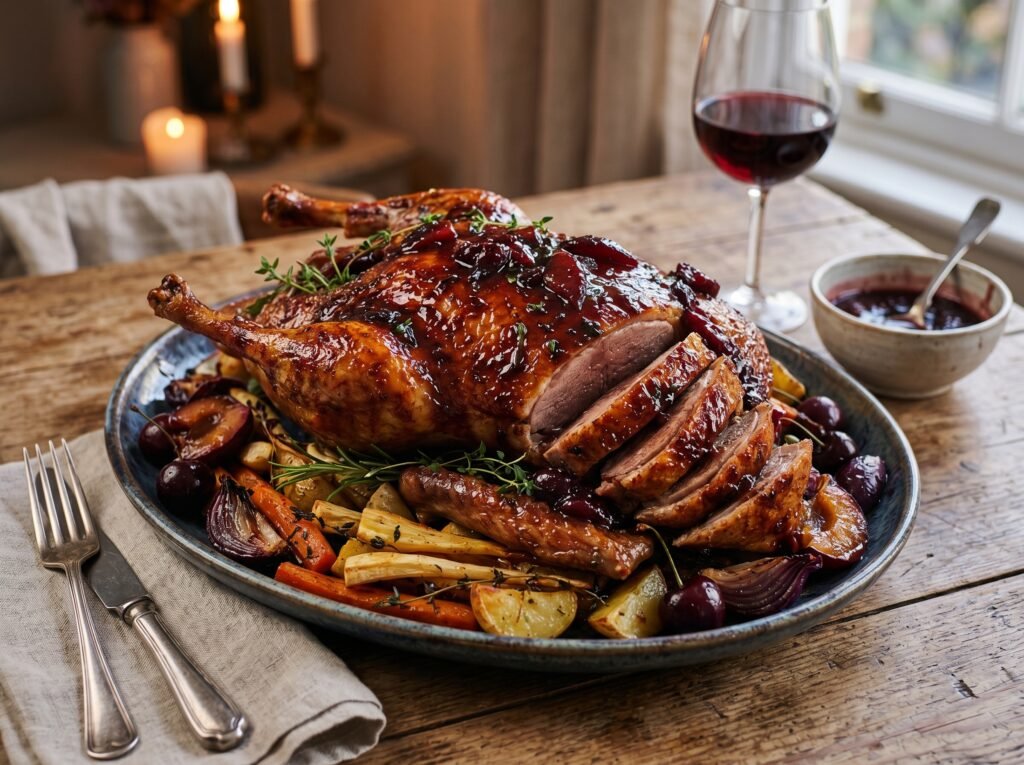
When looking for a deeply luxurious, restaurant-quality center-piece dinner that delivers the ultimate contrast in textures, Slow-Roasted Duck with Plum Glaze stands completely unrivaled. Far from a greasy, rubbery bird or a dry, stringy roast, a masterfully executed duck is a study in thermal fat rendering and skin dehydration. It features incredibly tender, succulent meat encased in a shatteringly crisp, mahogany-colored skin, all complemented by a sticky, tart-sweet plum reduction. If your homemade roasted duck consistently turns out tough with a thick layer of unrendered, chewy fat beneath a soft skin, it all comes down to subdermal fat liquidation, skin-surface desiccation, and fruit acid balancing.
The culinary science secret behind a meltingly tender duck with paper-thin, crackling skin is the Subdermal Scoring, Low-and-Slow Fat Liquidation, and High-Heat Flash Crisping Strategy. Duck contains a exceptionally thick layer of subcutaneous fat beneath its skin, which acts as an insulator. If you blast the bird with high heat immediately, the skin cooks and hardens before the underlying fat can melt, trapping a greasy, rubbery layer beneath the surface. By scoring the skin in a tight diamond pattern (without piercing the actual meat) and roasting it low and slow at $150^\circ\text{C}$ ($300^\circ\text{F}$), you give the dense fat ample time to liquefy (render) and slowly drip out of the scores, essentially basting the meat from the outside. Concurrently, plums are packed with natural pectin and tart malic acids. Simmering them down with star anise and soy sauce creates a glaze whose high sugar content caramelizes beautifully when the oven heat is cranked up to $220^\circ\text{C}$ ($425^\circ\text{F}$) for the final flash-crisp, snapping the dehydrated skin into a flawless, glass-like crunch.
Why You’ll Love This Feast Masterpiece
- Shatteringly Crisp Skin: A rigorous drying and roasting process completely liquefies the underlying fat, transforming the skin into a paper-thin, crunchy shell.
- Meltingly Tender Meat: Low-temperature roasting breaks down the tough connective tissues in the duck legs and breast, yielding incredibly juicy, rich meat.
- The Ultimate Sweet-Tangy Balance: The vibrant acidity of fresh plums cuts clean through the luxurious richness of the duck fat, resetting your palate with every bite.
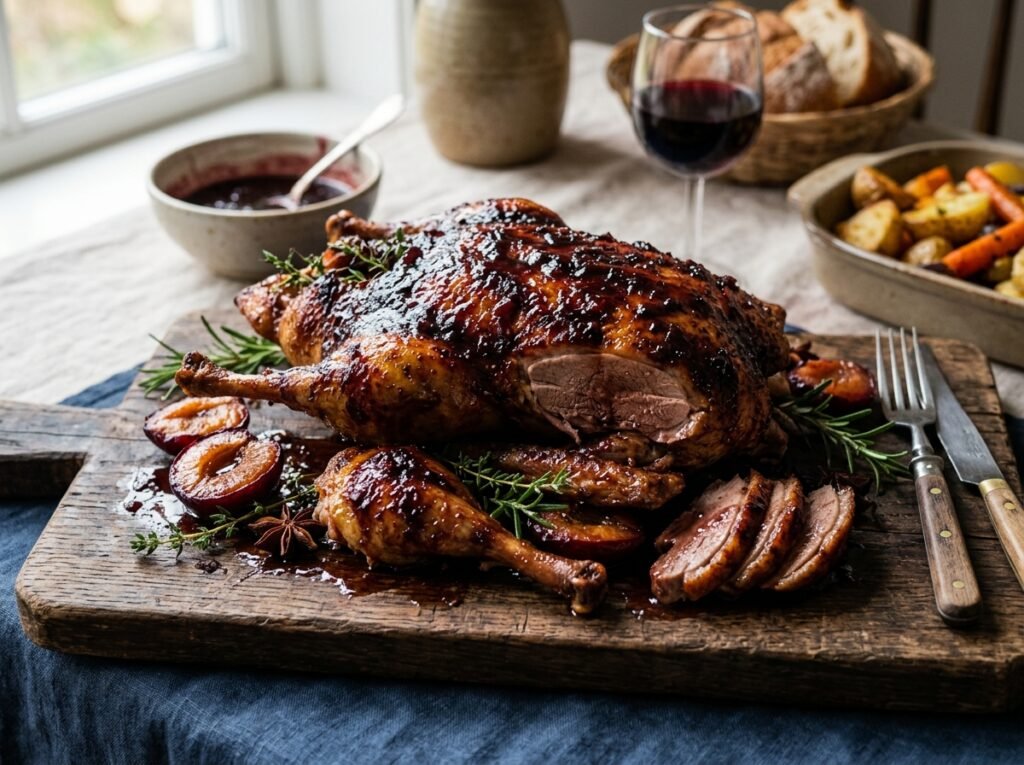
- A Show-Stopping Presentation: The lacquered, deep-red gloss of the plum glaze creates a breathtaking centerpiece worthy of any holiday or celebration.
Key Ingredients Overview
- Whole Whole Pekin Duck: The ultimate choice for roasting. Pekin duck has a fantastic meat-to-fat ratio and a skin structure that responds beautifully to dehydration and crisping.
- Fresh Red or Black Plums: The acidic, sweet glaze engine. Plums provide natural sugars for caramelization and a sharp tartness that balances the heavy, savory notes of the waterfowl.
- Chinese Five-Spice and Star Anise: The aromatic anchors. These warm spices feature distinct notes of cinnamon, fennel, and licorice that cut through the gamey depth of the duck.
- Soy Sauce and Honey: The umami-sweet glaze base. Soy sauce provides a deep savory saltiness, while honey ensures the glaze develops a sticky, lacquered sheen under the heat.
Step-by-Step Instructions
1.The Subdermal Scoring and Boiling Water Scald:10 min.
Preheat your oven to 150°C (300°F). Use a sharp knife to score the duck skin in a tight diamond pattern, taking care to only cut through the white fat layer without piercing the meat beneath. Place the duck on a rack over the sink and pour a kettle of boiling water completely over the skin. The hot water will instantly cause the skin to shrink and tighten, opening up the scores to maximize fat rendering.
2.The Aromatic Cavity Stuffing and Drying:10 min.
Pat the duck completely bone-dry inside and out with paper towels. Rub the interior cavity with a teaspoon of Chinese five-spice powder and fine salt, then stuff it with the sliced ginger, crushed garlic, and halved green onions. Prick the skin all over with a toothpick at an angle to create extra micro-vents for escaping fat.
3.The Low-and-Slow Fat Liquidation Roast:2 hours.
Place the duck breast-side up on a wire rack set inside a large roasting pan. Slide it into the oven and roast at 150°C (300°F) for 2 full hours. Every 45 minutes, carefully prick the skin again and spoon out the rendered clear duck fat from the bottom of the pan (save this liquid gold in a jar for the best roasted potatoes of your life!).
4.The Tart-Sweet Plum Glaze Reduction:20 min.
While the duck roasts, build the glaze. Combine the chopped plums, honey, soy sauce, rice vinegar, brown sugar, and whole star anise in a small saucepan over medium heat. Simmer for 15–20 minutes until the plums completely break down. Strain the mixture through a fine-mesh sieve, pressing firmly to extract a thick, glossy, ruby-red glaze.
5.The High-Heat Caramelized Glaze Flash:20 min.
Pull the duck out of the oven and turn the heat up to 220°C (425°F). Use a pastry brush to paint a generous layer of the plum glaze completely over the duck skin. Slide it back into the hot oven for 15–20 minutes, watching closely. The intense heat will rapidly caramelize the fruit sugars, snapping the skin into a crispy, mahogany crust.
6.The Thermal Relaxation and Carving Present:15 min.
Remove the duck from the oven and let it rest undisturbed on a cutting board for 15 minutes. This allows the internal juices to redistribute back into the muscle fibers, ensuring the meat stays incredibly juicy. Carve into clean slices and serve alongside the remaining warm plum glaze.
Expert Tips for Success
- The No-Meat Scoring Rule: When scoring the skin of the duck, be incredibly gentle. Your knife should slide easily through the soft, white sub-cutaneous fat layer but stop short of touching the dark meat underneath. If you puncture the meat, the internal juices will escape during roasting, drying out the duck and preventing the skin from getting truly crisp due to the escaping water vapor.
- Save the Rendered Fat: Do not discard the clear fat that pools at the bottom of your roasting pan. Duck fat has a remarkably high smoke point and a rich, savory flavor. Strain it through a coffee filter or fine sieve into a glass jar and keep it in your fridge. It is the absolute holy grail medium for roasting potatoes, searing steaks, or frying eggs.
- The Rest is Mandatory: Resist the temptation to carve the duck immediately after pulling it from the intense high-heat flash. Letting the bird rest for 15 minutes relaxes the tightened protein fibers, locking the rich juices inside the meat. If you carve too early, all that delicious moisture will instantly flood your cutting board, leaving you with dry meat.
The Recipe Card
- Prep Time: 20 mins
- Cook Time: 2 hours 20 mins
- Total Time: 2 hours 40 mins
- Yield: 4 Elegant, Rich Servings
Ingredients:
- The Main Event: 1 Whole Pekin Duck (approx. 2–2.5 kg / 4.5–5.5 lbs).
- The Cavity Aromatics: 1 tbsp Fine Sea Salt, 1 tsp Chinese Five-Spice Powder, 1 Thumb Fresh Ginger (sliced), 4 Cloves Garlic (smashed), 3 Whole Green Onions (halved).
- The Velvet Plum Glaze: 6 Fresh Red or Black Plums (pitted and chopped), 4 tbsp Honey, 3 tbsp Low-Sodium Soy Sauce, 2 tbsp Rice Vinegar, 2 tbsp Light Brown Sugar, 2 Whole Star Anise.
Instructions:
Preheat oven to 150°C (300°F). Score the duck skin in a tight diamond pattern without cutting into the meat. Scald the skin with a kettle of boiling water over the sink, then pat completely dry inside and out with paper towels. Season the cavity with salt and five-spice, then stuff with ginger, garlic, and green onions. Place the duck breast-side up on a wire rack inside a roasting pan and roast for 2 hours, occasionally pricking the skin to release fat. Meanwhile, simmer the plums, honey, soy sauce, vinegar, brown sugar, and star anise in a saucepan for 20 minutes until broken down; strain into a smooth glaze. Crank the oven to 220°C (425°F). Brush the duck generously with the plum glaze and roast for an additional 15–20 minutes until the skin is deeply lacquered and crisp. Rest for 15 minutes before carving, and serve with extra glaze.
